
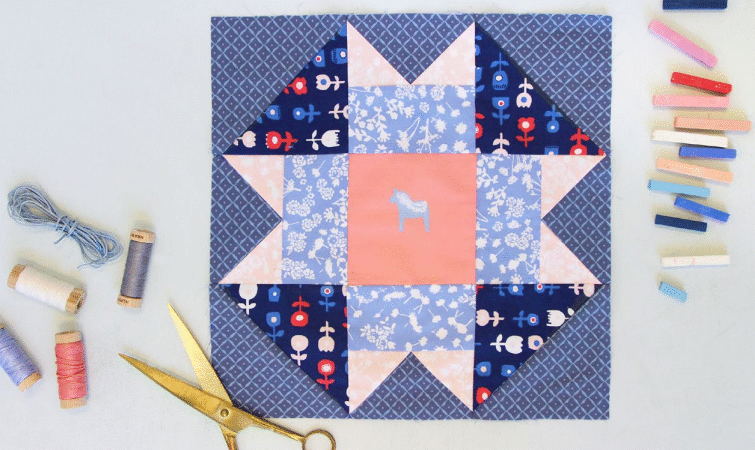
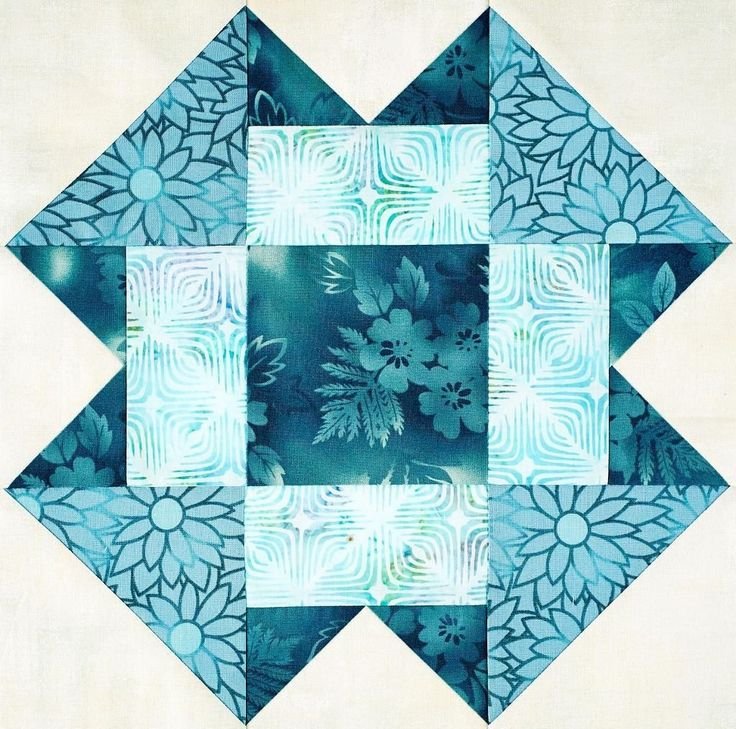
The Folded Corners quilt block combines several useful patchwork techniques in one balanced 12-inch design. A fussy-cut center creates the focal point, four Flying Geese units add directional movement, and large half-square triangles complete the outer corners. The result looks detailed without requiring templates, curved seams, or foundation paper piecing.
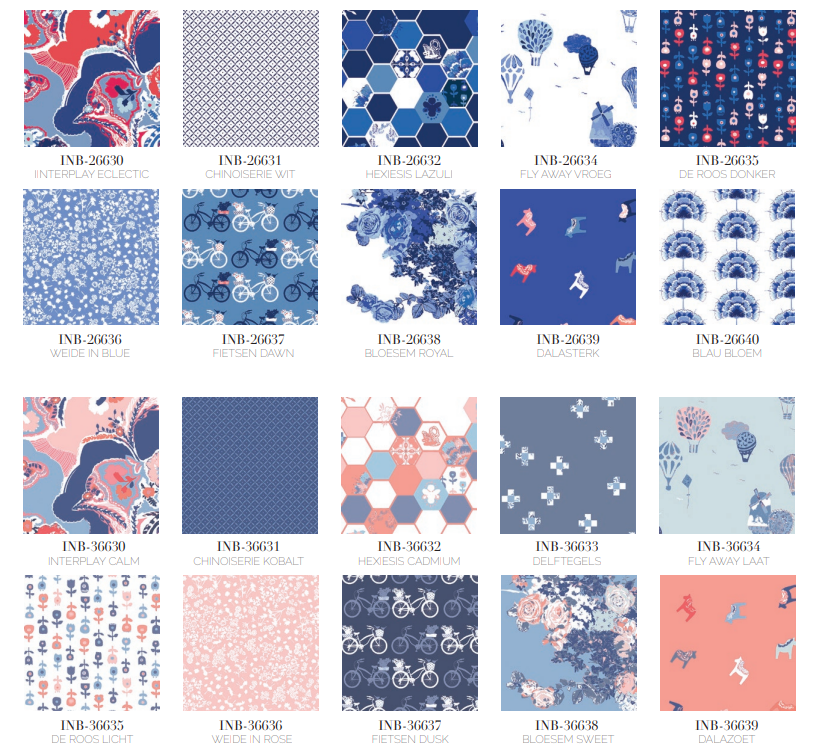
This block was designed by AGF Studio and originally featured fabrics from the In Blue collection by Katarina Roccella. The free PDF contains the official cutting measurements and construction diagrams. This companion guide adds practical help with fabric value, no-waste Flying Geese, four-at-a-time half-square triangles, pressing, point matching, troubleshooting, and quilt planning.
Folded Corners Block at a Glance
- Finished block size: 12 × 12 inches
- Unfinished block size: 12 1/2 × 12 1/2 inches
- Skill level: Confident beginner to intermediate
- Main techniques: No-waste Flying Geese, four-at-a-time half-square triangles, fussy cutting, and row assembly
- Seam allowance: 1/4 inch, included in the PDF measurements
- Fabric groups: Five coordinating fabrics labeled A through E
- Best feature: A generous center square that can showcase a favorite motif
The finished design is arranged as a three-by-three grid of 4-inch finished units. Understanding that grid makes the block much easier to assemble and square accurately.
Important Correction to the Previous Article
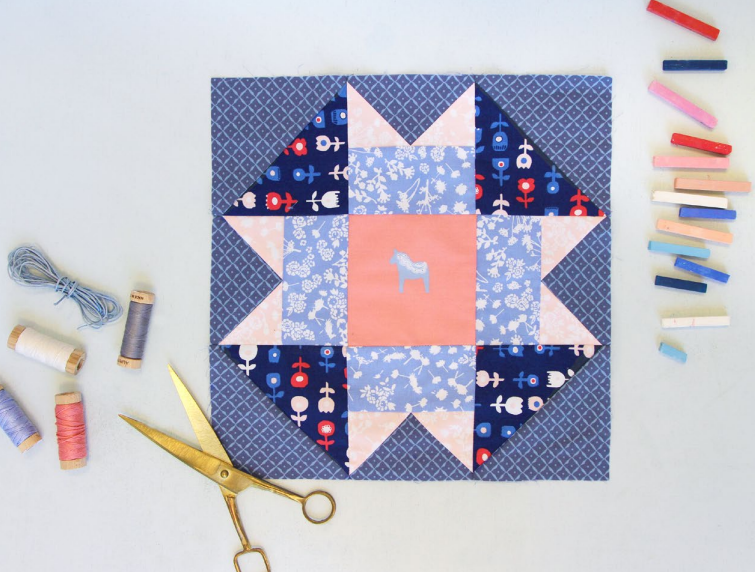
This design is more than a large square with four small stitch-and-flip corners. The accompanying AGF pattern uses three distinct sections:
- Four large half-square triangle units for the outer corners;
- Four Flying Geese units joined to contrasting strips;
- One center square.
These nine units form three rows. Following the construction shown in the PDF will produce the intended AGF Studio block and a 12-inch finished size.
Materials and Tools
Gather the following supplies before cutting:
- Five coordinating quilting cottons
- The official Folded Corners Block PDF
- Rotary cutter with a sharp blade
- Self-healing cutting mat
- Acrylic quilting rulers
- Sewing machine with a reliable 1/4-inch foot
- Fine cotton or polyester piecing thread
- Removable fabric marker or pencil
- Fine pins or quilting clips
- Iron and pressing surface
- 4 1/2-inch square ruler for the component units
- 12 1/2-inch square ruler for the finished block
- Optional rotating cutting mat
- Optional tailor’s clapper
Choose fabrics with a similar weight and weave. Quilting cotton is ideal because it remains stable during the diagonal cutting used for the half-square triangles.
Understanding the Five Fabric Roles
The pattern labels the fabrics A through E. Thinking of them by function can make substitutions easier.
| Fabric | Role in the Block | Selection Advice |
|---|---|---|
| A | One side of the large corner HSTs | Choose a noticeable medium or dark value |
| B | Rectangular bars beside the Flying Geese | Use a fabric that separates the geese from the center |
| C | Second side of the HSTs and the Flying Geese body | Select a contrasting value that repeats across the block |
| D | Small triangles in the Flying Geese | Use a color that stands clearly against Fabric C |
| E | Center focal square | Ideal for fussy cutting a recognizable motif |
The fabrics do not need to match the original blue collection. Solids, batiks, small prints, and scraps can all work as long as the values remain distinct.
Choosing Fabrics With Enough Contrast
The design can lose definition when Fabrics A and C are too similar or when Fabrics C and D blend together. Check both relationships before cutting.
Place the five fabrics together and photograph them with a phone. Convert the image to black and white. Fabric E should remain an obvious focal point, the corner HSTs should show two different values, and the Flying Geese should still be visible.
If two fabrics become nearly the same gray, replace one with a lighter or darker option. Contrast can come from value even when every fabric belongs to the same color family.
Fussy Cutting the Center
Fabric E becomes the center square and provides space for a featured print. To fussy cut it:
- Make a transparent template matching the cutting size listed in the PDF.
- Mark the template’s center and quarter-inch seam allowance.
- Position the motif inside the area that will remain visible after sewing.
- Check the direction of the print before cutting.
- Cut one test center before preparing additional blocks.
Avoid placing an important part of the motif within 1/4 inch of a raw edge, since it will disappear into a seam.
Preparation Before Sewing
Read the PDF from beginning to end before cutting. The two triangle techniques use differently sized squares, so keep those pieces in separate labeled groups.
- Press the fabric before measuring it.
- Confirm that the printed PDF is set to 100% or actual size if any page includes a measurement reference.
- Test the machine’s 1/4-inch seam allowance.
- Label Fabrics A through E with removable notes.
- Keep the large HST squares separate from the no-waste Flying Geese pieces.
- Wind an extra bobbin before chain piecing.
- Prepare a small design board for the nine final units.
The pattern includes seam allowances in its cutting measurements. Do not add another allowance.
Technique 1: Four-at-a-Time Half-Square Triangles
The four corner units are created from one large Fabric A square and one large Fabric C square. The method produces four matching HSTs at once.
How the Method Works
- Place the two large squares right sides together and align all four edges.
- Sew around the entire outside perimeter with a consistent 1/4-inch seam.
- Cut the stitched square on both diagonals to create four triangular sections.
- Open each section carefully and press the seam.
- Square every HST to 4 1/2 inches as directed by the pattern.
This method is efficient, but every outside edge of the new HSTs is on the bias after cutting. Support each unit fully when moving it and use a lifting motion with the iron instead of sliding it.
Pressing the HSTs
Set the seam with the unit closed, then press it open or toward the darker fabric. If pressing to one side, verify that all four corner units are treated consistently so the finished rows behave the same way.
Allow each unit to cool before trimming. Warm bias edges stretch more easily.
Squaring the HSTs
Place the ruler’s 45-degree line directly on the diagonal seam. Trim two adjacent edges, rotate the unit, and trim the remaining edges to 4 1/2 inches.
The seam should reach the corners precisely. If it does not, check whether the starting squares shifted or the perimeter seam became wider than 1/4 inch.
Technique 2: Four No-Waste Flying Geese
The PDF uses the no-waste method to create four Flying Geese from one larger Fabric C square and four smaller Fabric D squares.
First Sewing Sequence
Draw one diagonal line on the wrong side of every small square. Place two small squares on opposite corners of the larger square as illustrated in the pattern. Their diagonal lines should form one continuous line across the larger square.
Sew 1/4 inch on both sides of the marked line, then cut on the line. Press the two resulting heart-shaped units toward the smaller triangles.
Second Sewing Sequence
Place one remaining small square on the open corner of each unit. Sew 1/4 inch on both sides of the marked diagonal and cut on the line. Repeat with the other unit.
The process creates four matching Flying Geese without discarded corner triangles.
Check the Geese Before Continuing
Each goose should have:
- A centered top point;
- A visible 1/4-inch allowance above the point;
- Two lower diagonal seams that reach the corners;
- Straight outer edges;
- The unit measurement specified in the PDF.
Do not remove the 1/4-inch fabric above the top point while trimming. That allowance protects the point when the next strip is attached.
Adding the Fabric B Strips
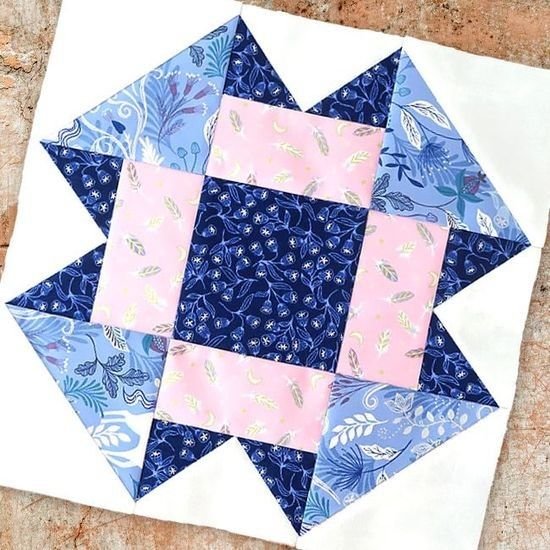
The pattern pairs each Flying Geese unit with a Fabric B rectangle. These combinations become the four units surrounding the center square.
Before sewing, arrange all four units around Fabric E. Confirm whether the geese point toward or away from the center according to the official diagram. Directional mistakes are easier to fix before the strips are attached.
Match the center of the rectangle with the top point of the goose. Sew with the goose on top when possible so the intersection remains visible. Stitch just outside the point rather than through it to preserve the full triangle.
Press all four units consistently. They should finish at the same 4 1/2-inch unfinished size as the center square and corner HSTs.
Arranging the Nine Units
Lay out the block as a three-by-three grid:
- Four HST units occupy the outside corners;
- Four Flying Geese-and-strip units occupy the middle position of each side;
- Fabric E occupies the center.
Rotate the HSTs and Flying Geese to match the PDF diagram. Take a photograph of the layout before joining the rows. A quick photograph is useful if a unit becomes turned at the sewing machine.
Sewing the Rows
Join the units into three horizontal rows. Match important intersections before aligning the rest of each edge.
Press the first and third rows in one direction and the center row in the opposite direction. Alternating directions allows the seams to nest when the rows are joined.
When sewing the three rows together:
- Insert a pin through each matching seam intersection.
- Align the raw edges without stretching them.
- Sew with the most visible triangle points facing upward.
- Slow down as the needle approaches each intersection.
- Check the front of the block before pressing the final seams.
If a point is slightly short, resewing a small portion of the seam may correct it. Avoid trimming the outside edge until the full block has been measured.
Final Measurement and Squaring
The completed block should measure 12 1/2 inches unfinished and finish at 12 inches after being sewn into a quilt.
Place a large square ruler over the block and check:
- The center square is centered;
- The middle units align with the 6 1/4-inch centerlines;
- The four outer corners remain square;
- A 1/4-inch seam allowance remains beyond every outer point;
- Opposite edges are parallel.
Trim only narrow slivers. If the block is significantly small, first inspect the component sizes and seam allowances. Cutting it smaller may make the outside points disappear in the final quilt.
Troubleshooting Common Problems
The HST units are distorted
The four-at-a-time method creates bias edges. Use minimal steam, press without sliding, and allow the units to cool before trimming.
The Flying Geese top points are cut off
The point may not have had a full 1/4-inch allowance, or the next seam may have crossed directly through it. Stitch just outside the point where possible.
The Flying Geese are too small
Check whether the seams were sewn exactly 1/4 inch away from the marked diagonal. Also confirm that the PDF measurements were followed without adding or subtracting seam allowance.
The center looks twisted
One of the surrounding units may be rotated. Return the block to a flat layout and compare each section with the official diagram before joining rows.
The rows do not match
Measure every component before row assembly. All nine grid units should be 4 1/2 inches unfinished. Correct an undersized component instead of easing it into the row.
The block will not lie flat
Inconsistent pressing or stretched bias edges may create fullness. Press the final row seams open if nesting creates too much bulk, then use a clapper while the block cools.
Quilt Planning With 12-Inch Finished Blocks
The following dimensions do not include sashing, borders, or binding.
| Layout | Blocks Needed | Approximate Patchwork Size |
|---|---|---|
| 2 × 2 | 4 | 24 × 24 inches |
| 3 × 4 | 12 | 36 × 48 inches |
| 4 × 5 | 20 | 48 × 60 inches |
| 5 × 6 | 30 | 60 × 72 inches |
| 6 × 7 | 42 | 72 × 84 inches |
| 7 × 8 | 56 | 84 × 96 inches |
For a less busy layout, alternate Folded Corners blocks with plain 12-inch squares. Narrow sashing also gives the points more breathing room and makes each fussy-cut center easier to appreciate.
Color and Layout Ideas
Blue and White
Use the original collection as inspiration by combining cobalt, sky blue, white, and a small warm accent. Mix light and dark blues to preserve the geometry.
Modern Solids
Choose a dark background, saturated Flying Geese, and a bright center. Solids emphasize the sharp angles and repeated grid.
Romantic Florals
Use cream, rose, burgundy, sage, and dusty blue. Reserve the largest floral motif for Fabric E and use smaller prints elsewhere.
Autumn Palette
Combine rust, gold, olive, deep red, and warm beige. A dark Fabric C can create a strong frame around the center.
Scrappy Version
Keep Fabric B or C consistent across every block and change the remaining fabrics. One repeated fabric will unify the quilt even when the centers are all different.
Project Ideas
A single Folded Corners block can become a pillow front, mini quilt, or tote-bag panel. Three blocks make an attractive table runner, while four can create the center of a wall hanging.
For larger quilts:
- Set the blocks edge to edge for strong secondary patterns;
- Add sashing to separate the individual designs;
- Rotate alternate blocks by 90 degrees;
- Use different fussy-cut centers in a themed sampler;
- Alternate with the Double Aster Block Pattern for a more intricate sampler;
- Combine with the Bitty Basket Quilt Block in a multi-scale row quilt.
Frequently Asked Questions
Is this the same as a Snowball block?
No. A Snowball generally begins with one large square and uses stitch-and-flip squares on its four corners. This AGF Studio design uses HSTs, no-waste Flying Geese, rectangles, and a separate center square arranged in a nine-unit grid.
Is the block beginner-friendly?
A confident beginner can make it after practicing HSTs and Flying Geese. The techniques are straightforward, but accurate trimming and point matching are important.
Can the pattern be resized?
Because the block combines several unit types, every measurement must remain compatible with the three-by-three grid. Use the 12-inch measurements supplied in the PDF unless you are comfortable recalculating HSTs and Flying Geese.
Can directional prints be used?
Yes, but both four-at-a-time methods rotate or mirror the fabric. Make one test set before cutting all the blocks if print direction matters.
Should the seams be pressed open or to one side?
The PDF recommends alternating pressing directions when assembling the rows. Individual units can be pressed to one side, while a particularly bulky final seam may be pressed open.
Download the Free Folded Corners Block PDF
Use the original pattern for the complete cutting measurements and illustrated construction sequence:
Folded Corners Block Pattern PDF
Pattern Credit
The Folded Corners Block was designed by AGF Studio and published by Art Gallery Fabrics / Art Gallery Quilts LLC in 2017. The original sample features the In Blue fabric collection designed by Katarina Roccella. The official Art Gallery Fabrics blog tutorial was presented by Melissa.
Easy Quilting Patterns does not claim authorship or ownership of the original block pattern, instructions, diagrams, fabric artwork, or PDF design. All pattern credit and rights remain with AGF Studio, Art Gallery Fabrics, Art Gallery Quilts LLC, Katarina Roccella, and the respective creators.
Visit the original Art Gallery Fabrics tutorial
Final Thoughts
The Folded Corners block is valuable because it combines multiple techniques in one organized grid. The HST corners teach careful bias handling, the Flying Geese develop diagonal-seam accuracy, and the center provides an opportunity for thoughtful fabric placement.
Make one practice block before cutting a full quilt. Measure every 4 1/2-inch component, photograph the final layout, and preserve the quarter-inch allowance beyond each point. Those checks will make repeated blocks faster, flatter, and more consistent.