
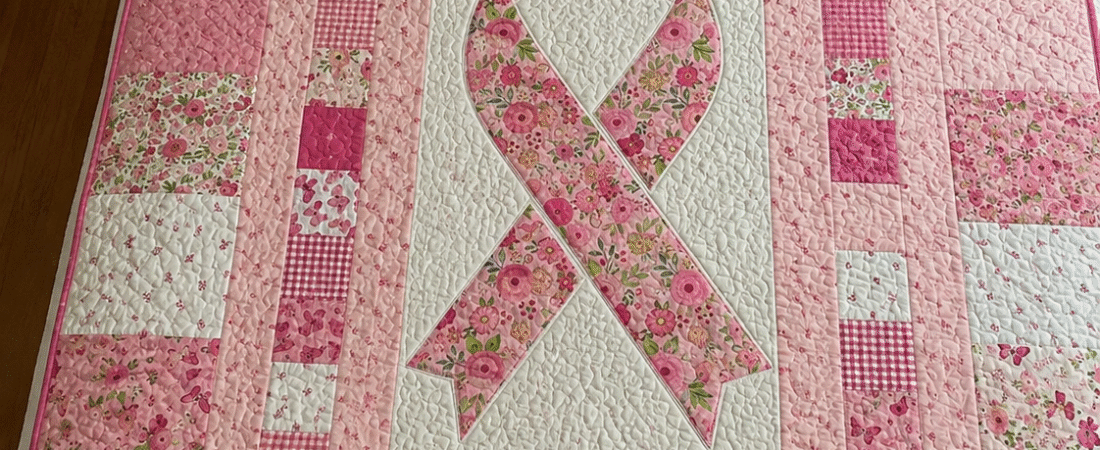
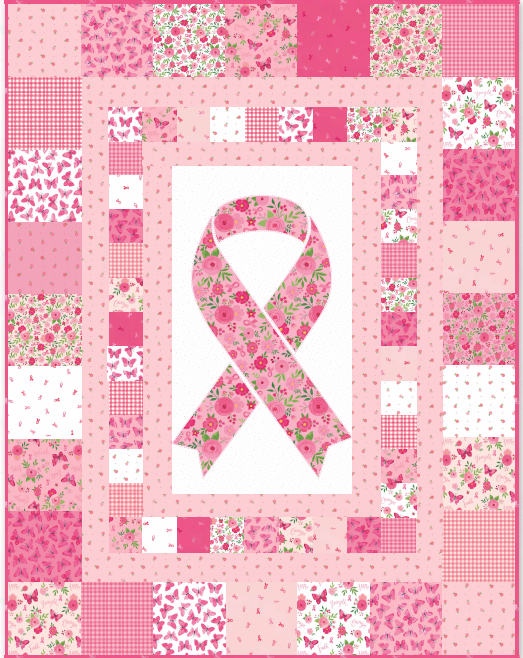
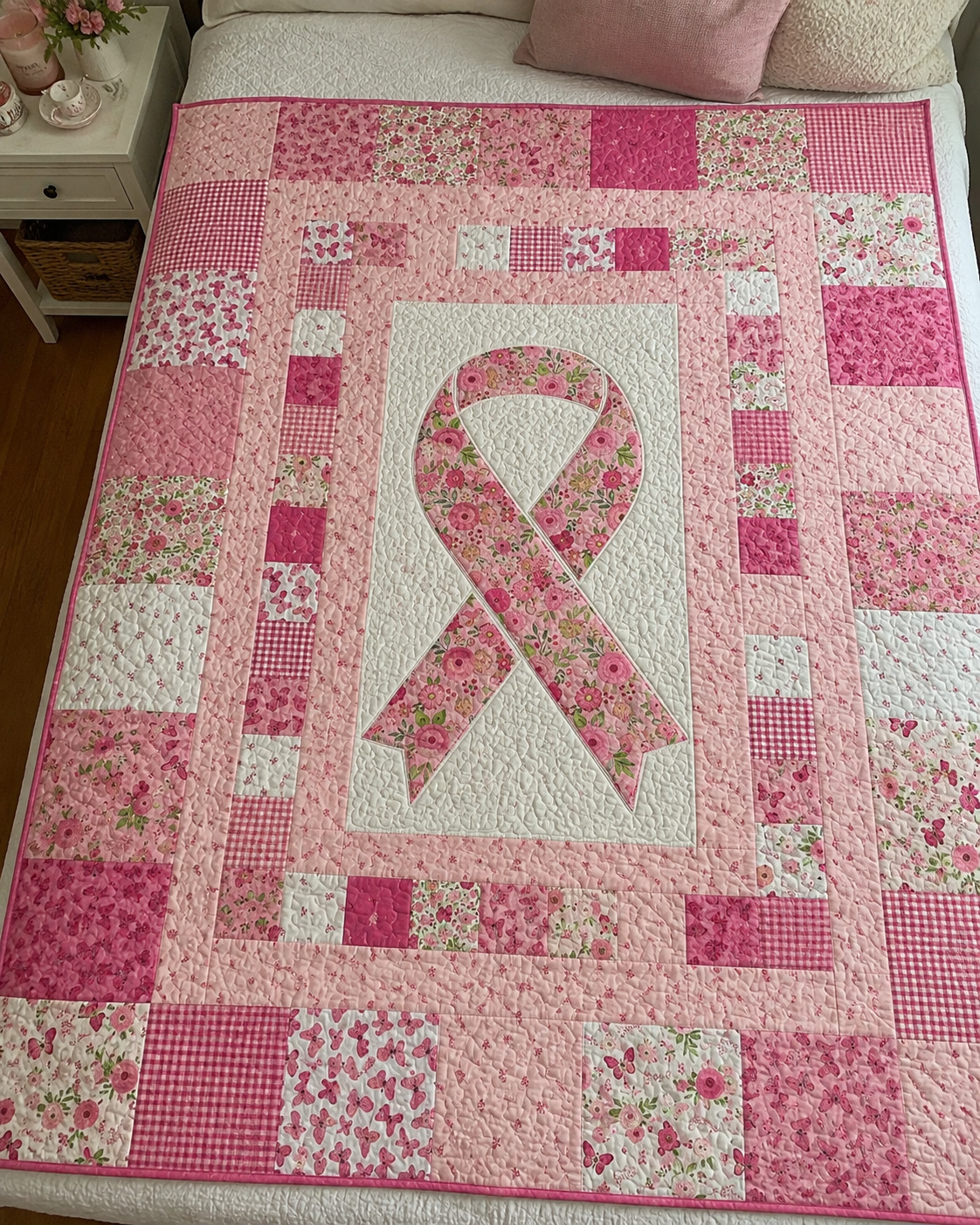
The Strength in Pink Hope Quilt surrounds a floral awareness-ribbon panel with four expanding patchwork borders. Its pink florals, butterflies, ginghams, ribbons, and encouraging words create a meaningful design that can be made as a comfort quilt, a thoughtful gift, or a personal project celebrating resilience and support.
This is a panel quilt rather than a traditional block quilt. The large ribbon motif remains intact in the center, while 5-inch and 10-inch precut squares create colorful frames around it. That construction makes the project approachable, but a polished result still depends on accurate panel trimming, consistent seams, and correctly measured borders.
Riley Blake Designs released the pattern for its Strength in Pink fabric collection. The current official PDF is a four-page, 2023 edition with the fabric requirements, cutting information, diagrams, and assembly sequence. This independently written guide explains the planning and techniques that will help you use that pattern successfully; it does not replace the designer’s measurements or instructions.
Pattern at a Glance
| Detail | Information |
|---|---|
| Official pattern name | Strength in Pink Hope Quilt |
| Publisher and pattern credit | Riley Blake Designs / RBD Designers |
| Fabric collection | Strength in Pink |
| Quilt style | Center-panel quilt with four pieced borders |
| Finished size | 67½″ × 86½″ |
| Skill level | Beginner, according to the official pattern cover |
| Main techniques | Fussy trimming a panel, sewing strip frames, assembling square borders, measuring through the center, and binding |
| Seam allowance | 1/4″ unless otherwise stated in the PDF |
| Original precuts | Strength in Pink 5-inch and 10-inch Stackers |
The finished proportions are long enough for a generous throw, a comfort quilt, or decorative use on a twin bed. Before calling it a bed quilt, measure the intended mattress and decide how much side and foot coverage you want. Mattress depth varies, and 67½″ × 86½″ may provide a different drop from one bed to another.
Use the Current Four-Page Pattern
An older three-page version of the Hope Quilt is still circulating online. That 2022 file has a different cover, condenses the construction directions, and even refers to an unrelated “Easter Parade” 5-inch Stacker in its cutting section. The current four-page Riley Blake file is dated 2023, names the Strength in Pink materials correctly, provides more detailed diagrams, and should be the version used for a new project.
Do not combine cutting directions from the older file with assembly directions from the revised file. Although both versions state the same finished size, their presentation and some intermediate measurements differ. Download the current file from Riley Blake Designs, save it with a clear filename, and discard any unmarked older printout so the two cannot be confused.
Riley Blake also advises makers to check its pattern-updates page before beginning. It is a sensible final check whenever a pattern has already appeared in more than one edition.
Understanding the Quilt’s Structure
The Hope Quilt grows outward in five clear stages:
- A tall floral pink-ribbon panel forms the center.
- A pale print creates the first rectangular frame.
- A border made from 5-inch precut squares adds small-scale patchwork.
- Another pale frame separates the two patchwork scales.
- A final border made from 10-inch precut squares gives the quilt its full size.
The two light frames are important. Without them, the small and large squares could blend into one busy mass. The quieter fabric creates breathing room, emphasizes the ribbon panel, and gives the eye a place to rest before moving into the next patchwork border.
The design does not require making repeated pieced blocks, half-square triangles, stars, or ribbon-shaped appliqué. The awareness ribbon is already printed on the panel. Most of the construction consists of joining rectangles and squares into accurately sized border sections.
That distinction matters when planning the project. You do not need to invent 5-inch block units or pair pink and white squares. Follow the panel-and-border layout shown in the official PDF.
Original Materials and Useful Substitutions
The current pattern is designed around these main components:
- One Strength in Pink 5-inch Stacker
- One Strength in Pink 10-inch Stacker
- One Strength in Pink ribbon panel
- A light Strength in Pink Daisies coordinate for the inner frames
- A dark pink ribbon print for binding
- Backing and batting sized for the completed quilt
The PDF selects forty 5-inch squares and twenty-eight 10-inch squares from the precut packs. Check the official fabric and cutting lists before purchasing because the exact product codes and yardage are part of the pattern.
If the original collection is no longer available, the structure can be reproduced with a compatible panel and squares cut from coordinated yardage. Substitution is easiest when you preserve the same three roles:
| Fabric role | Visual purpose | Good substitute |
|---|---|---|
| Ribbon panel | Main message and focal image | A similarly proportioned awareness-ribbon or encouragement panel |
| Light frame fabric | Separates the patchwork borders | White, blush, pale pink, or a quiet low-volume print |
| 5-inch squares | Creates the smaller patchwork frame | Charm squares or squares cut from small- and medium-scale prints |
| 10-inch squares | Creates the bold outer frame | Layer-cake squares or squares cut from coordinated yardage |
| Binding | Provides a strong final outline | Dark pink, burgundy, plum, or another color repeated in the panel |
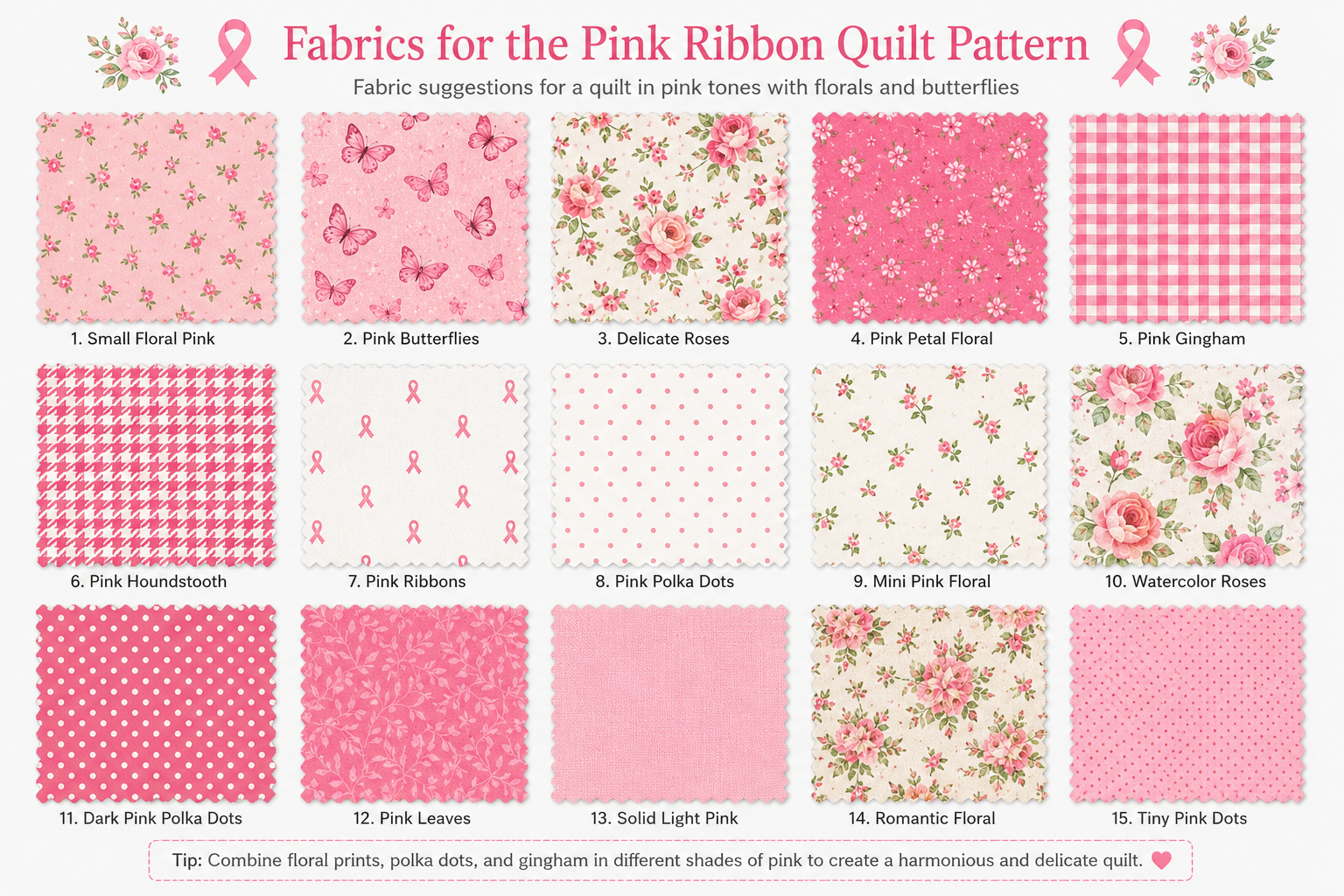
Do not buy substitute precuts solely because they are pink. Compare their undertones. Blue-pink, coral, blush, dusty rose, and magenta can work together, but a balanced collection usually needs repeated colors and a few quieter prints to connect them.
Choosing a Replacement Panel
The original ribbon panel is approximately 24″ × 43″ after the pattern’s trimming step. A replacement panel should have a similarly tall, narrow focal area and enough background around the artwork to preserve a seam allowance.
Before cutting a substitute:
- Identify the artwork that must remain visible.
- Measure the usable printed area rather than the raw panel edges.
- Compare those dimensions with the unfinished panel measurement in the current PDF.
- Decide whether a coping border can compensate for a modest difference.
- Confirm that the final center will still fit the first square border.
A panel that is slightly smaller may be adapted by widening the first light frame. A panel that is larger can be more difficult because trimming may remove text, flowers, or part of the ribbon. Make a scale sketch before cutting and keep the design centered visually, not merely between the selvages.
If you substantially change the center dimensions, every later border must be recalculated. That becomes a custom adaptation and is best attempted only after understanding the original construction.
Precut Squares: More Than a Shortcut
The two precut sizes give the quilt its rhythm. The 5-inch squares create a detailed inner border, while the 10-inch squares create broad areas of color around the outside. Using both scales prevents the top from looking like four plain yardage borders around a panel.
Precuts can vary slightly between manufacturers, and their pinked edges can make measuring confusing. Determine whether the stated size is measured from the peaks or valleys of the zigzag before sewing a test seam. Use the same reference point on every square.
If cutting squares from yardage, cut a small set first and compare them against one another. A strip that is even slightly wider at one end produces squares that do not align well in a long border row. A sharp rotary blade, a nonslip ruler, and fabric folded without a twist will improve accuracy.
Arrange all squares before sewing. Spread light, medium, and dark values around the four sides instead of allowing all saturated prints to collect in one corner. Separate identical prints when possible, and check directional words, ribbons, butterflies, or flowers before deciding their final orientation.
Take a photograph of the layout. The photo preserves the plan if the pieces are disturbed and makes value clusters easier to notice than looking at the fabric directly.
Color Planning for a Pink Quilt
A quilt can use many pinks without becoming visually flat. The secret is value and scale rather than the number of different prints.
Aim for a mix of:
- Very light pinks and white-background prints
- Medium blush, rose, and clear pink
- Deep pink or magenta accents
- Small geometrics or ginghams
- Medium floral and butterfly prints
- A few calm fabrics with open background space
Photograph the arranged squares in grayscale. If the outer border becomes one uniform gray, move a few lighter and darker squares into the row. The viewer should be able to distinguish the center panel, the first patchwork border, and the outer frame from across the room.
You may also adapt the palette to another awareness color or to the recipient’s preferences. Keep the light separator frames and strong value range even when changing the hue. The construction works because the borders are visually distinct, not because every fabric is pink.
Preparing Fabric and Testing for Color Transfer
Deep pink and red-violet prints can release excess dye. Test a small fabric sample according to the manufacturer’s care instructions before combining it with white or pale blush fabric. If using precuts, full prewashing can distort the small pieces; a controlled test with a spare square is safer than washing an entire precut pack without a plan.
If you decide to prewash yardage, do so before cutting and treat coordinating yardage consistently. Measure the panel again after washing because shrinkage may change the amount of usable background around the motif.
Press rather than stretch. Lift and lower the iron, especially on the long panel and border strips. A distorted panel may look square on the cutting mat but produce a wavy center after the first frame is attached.
Tools That Help With This Pattern
Basic quilting equipment is sufficient, but a few tools make the long borders more reliable:
- Rotary cutter with a fresh blade
- Large cutting mat
- Long acrylic ruler and square ruler
- Accurate 1/4″ presser foot or seam guide
- Fine pins or fabric clips
- Removable fabric marker
- Design wall, clean floor, or large table
- Painter’s tape or numbered labels for the four border positions
- Seam ripper for correcting an early alignment problem
- Walking foot for straight-line quilting
Calibrate the seam allowance before sewing the quilt. Join three accurately cut strips, press them, and measure the center strip. If the finished width is wrong, adjust the needle position or guide. Border rows contain many seams, so a small inaccuracy can change the row length substantially.
Trimming and Squaring the Ribbon Panel
The printed ribbon should appear centered and upright in the finished quilt. Printed panels are not always perfectly parallel with the fabric grain, so trim gradually and evaluate the artwork after every cut.
The official pattern explains how much background to leave outside the outer printed illustrations. Follow that current diagram rather than guessing from the raw panel edge. Before the final cut, mark the intended rectangle with removable tape or a fabric-safe marker and inspect it from several feet away.
Check these points:
- The top of the ribbon is not leaning noticeably.
- Similar amounts of background remain on the left and right.
- Important flowers and printed words are not inside the seam allowance.
- The panel matches the unfinished dimensions given in the PDF.
- All four corners are square.
If the print is mildly skewed, prioritize visual balance. Forcing the fabric grain perfectly square may make the ribbon look crooked. Severe skew may require a slightly wider first frame and careful recentering.
Building a Flat First Frame
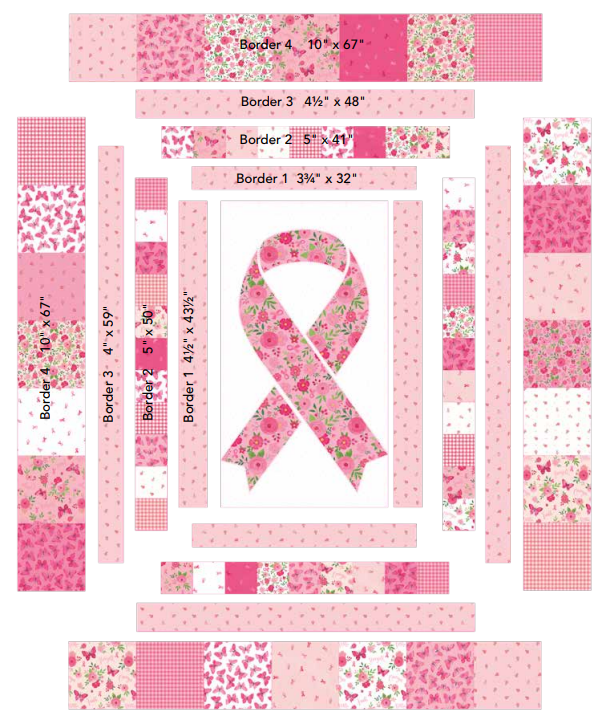
The light coordinate around the panel is assembled from size-specific strips and rectangles. Label the cut pieces exactly as Riley Blake does in the current PDF. Similar widths can be easy to confuse, especially when some strips are joined to create longer border pieces.
Before attaching anything, place the four completed frame sections around the panel. Confirm that the side pieces and top-and-bottom pieces are in the correct positions. Sew opposite sides first as directed, press, measure through the center, and then add the remaining pair.
Pin the center and ends before filling in the space between them. Do not stretch a border to reach the corner. If a piece does not fit, recheck the panel size, seam allowance, and strip labels rather than easing a large discrepancy into the seam.
After pressing, lay the framed panel on a flat surface. The center should be rectangular, the corners should remain at 90 degrees, and the border should not ripple.
Assembling the 5-Inch Square Border
The small-square border is made as four rows. The top and bottom rows contain fewer squares than the side rows because the center is rectangular. The current PDF gives the correct number, orientation, and target dimensions for each row.
To keep the patchwork balanced:
- Arrange all four rows around the framed panel before sewing.
- Rotate directional prints so they make sense on their side of the quilt.
- Mark the first square of each row with Top, Bottom, Left, or Right.
- Chain piece in pairs, then join the pairs while preserving the photographed order.
- Press the row seams consistently.
Measure the completed rows before attaching them. If a row is too long, inspect the seam allowances. Correcting several slightly shallow seams is better than taking a large seam at one end. If the row is too short, do not stretch it; find the cutting or seam error.
Attach opposite sides in pairs and use pins at the center, ends, and several intermediate points. The squares should remain square rather than becoming narrow rectangles through aggressive easing.
Adding the Second Light Frame
The next pale frame performs two jobs: it brings the center to the dimensions needed for the outer border and separates the 5-inch squares from the larger 10-inch squares.
This is an important accuracy checkpoint. Measure the quilt through the center in three places before cutting or finalizing border length. Use the method stated in the official pattern, sew the side borders first, and press in the direction shown in the revised diagrams.
If the center has developed a slight wave, correct it now. Adding a wide outer border will not hide a stretched inner edge; it will make the distortion more visible and harder to quilt.
Constructing the 10-Inch Outer Border
The outer border uses selected 10-inch squares sewn into four long rows. Because these squares have large motifs, their placement has a stronger visual effect than the smaller charm squares.
Distribute statement prints around the quilt. Avoid putting every large flower or dark gingham in the same row. If the prints include text or ribbons, orient them intentionally. A print on the left side may look best rotated differently from the same print on the top border.
Long rows can bow if seam allowances vary or if the iron stretches the edges. Sew with the squares supported on the table, not hanging from the machine. Press one section at a time and allow the row to cool flat.
Before attachment, compare the two side rows with one another and then compare the top and bottom rows. Opposite rows should match their pattern dimensions and should be equal within normal sewing tolerance.
High-Level Construction Roadmap
Keep the official PDF beside you for every exact measurement. The overall workflow is:
- Download the current four-page pattern and check for updates.
- Identify the ribbon panel, light frame fabric, 5-inch squares, 10-inch squares, and binding.
- Select and arrange the precut squares by value, scale, and direction.
- Trim the ribbon panel according to the official diagram.
- Cut and label the light-frame pieces.
- Assemble and attach the first frame around the panel.
- Sew the four 5-inch square rows and add them to the framed center.
- Assemble and attach the second light frame.
- Sew the four 10-inch square rows and attach the outer border.
- Measure the completed top, prepare the backing and batting, quilt, square, and bind.
This overview deliberately does not reproduce Riley Blake’s full cutting chart or row measurements. Those copyrighted instructions and diagrams are available in the official free PDF.
Measuring Borders Without Creating Waves
The edge of a quilt top can stretch during handling. For that reason, a border should be based on a center measurement rather than the longest outer-edge measurement.
Measure in three parallel places: near one edge, through the middle, and near the opposite edge. If the numbers differ slightly, use the center measurement or the approach specified by the pattern. Cut opposite border sections to exactly the same length.
Mark both the quilt edge and border at the center and quarter points. Match those marks, then distribute any tiny fullness evenly. Sew with the fuller layer against the feed dogs when practical so the machine can assist with gentle easing.
After each pair of borders:
- Press without dragging the iron.
- Check that the top lies flat.
- Confirm that the corners remain square.
- Measure through the center again.
- Fix an error before adding the next round.
A difference of a thread or two is normal. A border that must be pulled several inches to fit indicates a cutting, seam, or pattern-version problem.
Pressing and Seam Management
Follow the pressing direction in the current Riley Blake diagrams when one is shown. Consistent pressing keeps the patchwork rows flat and makes seam intersections easier to manage.
For the square borders, press sequential seams in one direction unless changing direction helps reduce a bulky intersection. Keep the long light-frame seams smooth and avoid stretching them with steam. If a fabric becomes shiny or discolored under heat, use a pressing cloth and lower temperature.
Finger-press a test seam before committing to a full row. Dark pink fabric may shadow through a pale border if the seam allowance is pressed toward the light fabric. In that situation, pressing toward the darker side may produce a cleaner appearance if it does not conflict with the construction.
Accuracy Checkpoints
| Stage | What to verify | Stop and correct if… |
|---|---|---|
| Pattern file | Current four-page 2023 edition | Your copy has only three pages or mentions Easter Parade |
| Ribbon panel | Correct unfinished size and centered motif | Ribbon leans or artwork enters the seam allowance |
| First frame | Flat rectangle with square corners | Border ripples or opposite sides differ |
| 5-inch rows | Correct square count, order, and target length | Row must be stretched to fit |
| Second frame | Center measurements match the PDF | Inner border has a wave or center bubbles |
| 10-inch rows | Opposite rows are equal and visually balanced | Large prints cluster in one area or row bows |
| Completed top | Approximately 67½″ × 86½″ finished | Large difference suggests cumulative errors |
Do not chase a printed measurement by stretching fabric. A consistently flat top that differs by a small amount is easier to quilt than an exact-size top forced into shape.
Common Problems and Fixes
The panel is not the expected size
Confirm that you are measuring after the trimming method shown in the revised pattern. If using the original panel, recheck the amount of background left around the illustrations. If using another panel, calculate a coping frame rather than trimming away important artwork.
The 5-inch row is too long
Measure several individual squares and several sewn units. A seam that is slightly too narrow across many joins can add significant length. Correct the seam allowance across the row instead of hiding all the excess in one seam.
The square border is too short
Do not pull it into place. Check whether the wrong number of squares was used, whether a piece was trimmed by mistake, or whether the framed center is oversized. If the difference is small and consistent, resewing shallow seam allowances may recover the needed length.
The border curves outward
The border may have been cut or assembled longer than the quilt center. Remove it, measure through the center, correct the row length, and pin at quarter points before reattaching.
The center bubbles
An outer border that is too short can draw the edges inward and leave fullness in the center. Recheck border length rather than attempting to flatten the bubble with dense quilting.
Directional words appear upside down
Lay all rows around the quilt before sewing. If a noticeable message is reversed, unpicking it before quilting usually produces a more intentional result. For subtle florals or butterflies, varied orientation may look natural.
The pale frame looks transparent
Dark seam allowances or colorful prints may shadow through a very light fabric. Press seams away from the light area when construction permits, trim stray dark threads, and consider a slightly denser low-volume substitute for a future version.
Quilting Ideas
The combination of a large printed panel and square borders supports several quilting approaches.
For a simple finish, use an allover meander, loops, hearts, ribbons, or gentle floral motifs. An open design keeps the quilt soft and is practical for a comfort quilt that may be washed frequently.
For structured quilting:
- Outline the awareness ribbon and major flowers in the panel.
- Add simple background quilting around the ribbon so the motif stands forward.
- Stitch parallel lines in the pale frames.
- Quilt diagonals, an X, or a gentle curve through each 5-inch square.
- Use a larger repeated motif in the 10-inch squares.
- Stitch near the seam on both sides of each major border to define the layers.
Stabilize the top first by quilting the main border seams or a widely spaced grid. Then add decorative detail. Keep quilting density reasonably balanced so one area does not draw up much more than another.
Test thread on scraps containing white, blush, and dark pink. A medium blush or very light pink may blend more gently across the palette than bright white. Check bobbin tension carefully because dark bobbin thread can show through the pale center.
Backing, Batting, and Binding
The revised pattern lists wide backing and a batting size that provides extra material beyond the finished quilt top. Confirm the exact requirements in the PDF and ask your longarm quilter about preferred overage before purchasing.
A low- or medium-loft washable batting suits a frequently used comfort quilt. Cotton blends provide drape, while polyester blends may be lighter and dry faster. Follow the batting manufacturer’s quilting-distance and care guidance.
The original dark pink ribbon print is used for binding. This creates a clear edge and repeats a design element from the quilt. If substituting, choose a medium-dark print or solid that remains distinct from the outer squares.
Prepare the binding only after measuring the quilt’s actual perimeter. Join strips with diagonal seams to distribute bulk, press the binding consistently, and test the chosen attachment method on a scrap quilt sandwich.
Making a Thoughtful Comfort or Donation Quilt
A handmade quilt can be a meaningful gesture, but the recipient’s preferences should guide the project. Some people love visible awareness symbols; others prefer a design that does not constantly reference illness. If possible, ask before choosing the panel and palette.
For a quilt intended for treatment, recovery, or regular washing:
- Select soft, washable materials.
- Avoid loose embellishments, beads, or rough decorative trims.
- Secure all seams and binding carefully.
- Wash with fragrance-free products if the recipient is sensitive.
- Include fabric and care information with the gift.
- Do not make medical or healing claims about the quilt.
If donating to a hospital, charity, or support organization, check its current size, fabric, batting, laundering, fragrance, smoke, and pet-exposure rules before sewing. Requirements vary, and a beautiful quilt may be declined if it does not meet that organization’s safety or handling standards.
Frequently Asked Questions
Is the Strength in Pink Hope pattern free?
Yes. Riley Blake Designs provides the current PDF as a free pattern. The document remains copyrighted and marked “All Rights Reserved,” so free access should not be confused with permission to republish or redistribute it.
What size is the finished quilt?
The official pattern states a finished size of 67½″ × 86½″. It is a generous throw or a possible twin-bed quilt depending on the desired mattress coverage.
Is it really beginner-friendly?
The current cover labels it beginner level. The sewing uses straight seams and square borders, but beginners should still calibrate their 1/4″ seam and measure every border before attachment.
Is the ribbon pieced or appliquéd?
Neither. The floral awareness ribbon is printed on the center panel. The maker trims the panel and frames it with pieced borders.
Does the pattern include multiple sizes?
No. The official pattern gives one finished size. Changing the size requires redesigning the border counts or adding a separately calculated outer border.
Do I need the original precut packs?
No. Squares can be cut from coordinated yardage or another collection, provided they match the sizes and quantities in the official cutting list. A replacement panel may require additional calculations.
Why are there two versions of the PDF?
An older 2022 three-page file remains online, while Riley Blake currently hosts a revised four-page 2023 edition. Use the current official file linked in this article and avoid mixing instructions.
Can I use another awareness color?
Yes. The construction can support another palette or symbolic panel. Preserve the contrast between the focal panel, light separator frames, small squares, and large outer squares.
Should I prewash the precuts?
Prewashing small precuts can cause fraying and distortion. Test spare fabric for color transfer, follow manufacturer care information, and prewash yardage consistently if you choose to prewash.
Can I sell a finished quilt made from the pattern?
The PDF does not provide a clear commercial-use license in the visible pattern text. Contact Riley Blake Designs for written guidance if you plan to sell finished quilts or use the design commercially.
Download the Official Updated Pattern
Use the current four-page file hosted directly by Riley Blake Designs. It contains the updated materials list, panel-trimming diagram, labeled cutting instructions, seventeen assembly steps, and final layout.
Download the official Strength in Pink Hope Quilt pattern
Save the PDF for personal reference, check the pattern-updates page, and keep the designer’s copyright notice intact. When sharing the project online, direct other makers to the official Riley Blake file instead of uploading a copy to another website.
Final Thoughts
The Strength in Pink Hope Quilt is effective because its construction supports its message. The central ribbon remains clearly visible, the pale frames protect it from visual clutter, and two scales of patchwork introduce variety without requiring complex blocks.
Success comes from a few disciplined habits: use the revised pattern, trim the panel carefully, plan the square placement before sewing, calibrate the seam allowance, and measure every border through the center. Those steps keep the long quilt top flat and allow the fabrics and ribbon motif to remain the focus.
Whether the quilt is made as a personal project or offered with the recipient’s wishes in mind, careful construction and thoughtful presentation give the finished piece lasting value.
Pattern Credit
The Strength in Pink Hope Quilt pattern and Strength in Pink fabric collection are credited to Riley Blake Designs / RBD Designers. The official pattern, quilt design, cutting instructions, diagrams, fabric artwork, product names, and original images belong to their respective rights holders. The current PDF is copyright © 2023 Riley Blake Designs and states “All Rights Reserved.”
This article is an independently written companion guide by Easy Quilting Patterns. Easy Quilting Patterns did not create the original pattern and is not affiliated with or endorsed by Riley Blake Designs. This guide does not reproduce or replace the complete pattern. Please download it from the official source above, keep its copyright notice intact, and do not upload or redistribute the PDF without express permission from the rights holder.